Architecture

We built the actor before we built the supervisor.

An internal system ran AI agents end to end, making its own decisions, for years before this. It taught us exactly what agents need before they can be trusted with money. The Agent Supervisor is what Agentic Finance needs next.

THE SYSTEM IN ONE PARAGRAPH

What it is.

The system is the operating system we built to run many AI agents on one job, so the work carries on as things change.

Technically, the system is a stateful runtime built on Linux. It coordinates specialized agents, three forms of memory, probabilistic and declarative reasoning, and software tools within one persistent operating environment, working toward a human-defined objective. Okren, the supervisor we built from what running it taught us, is the first product.

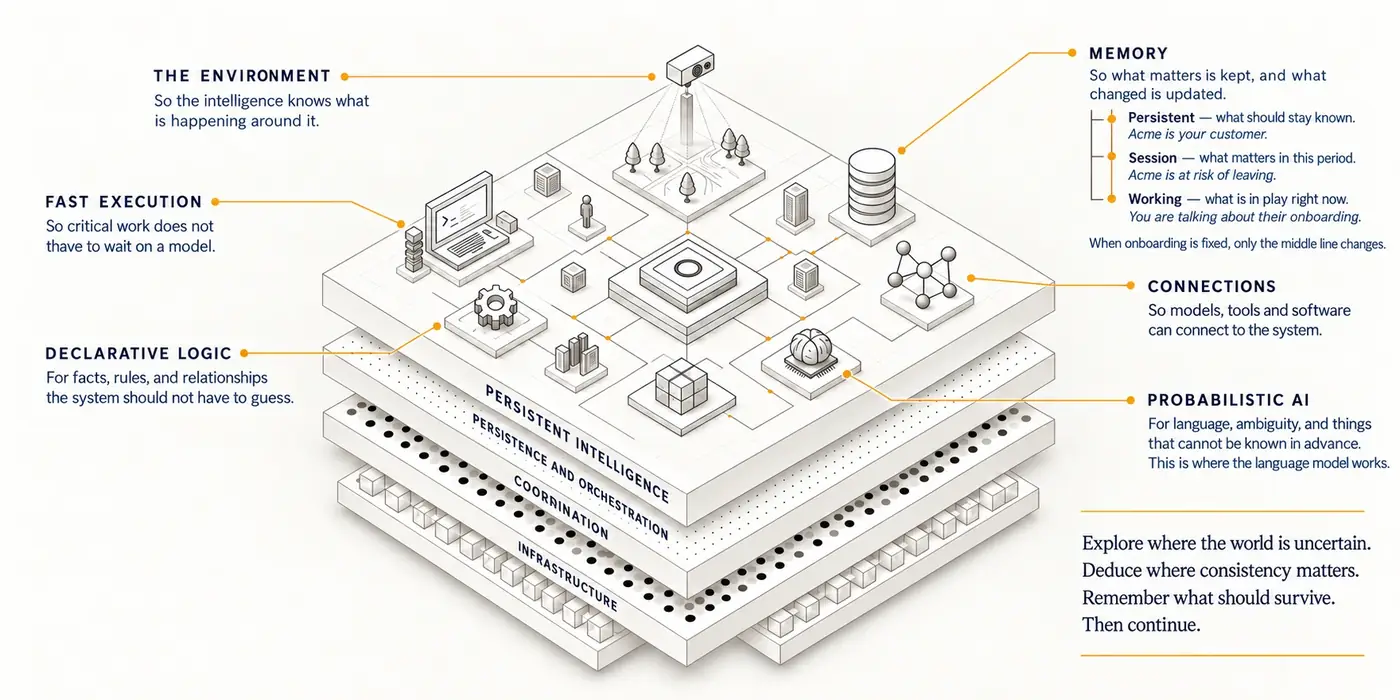
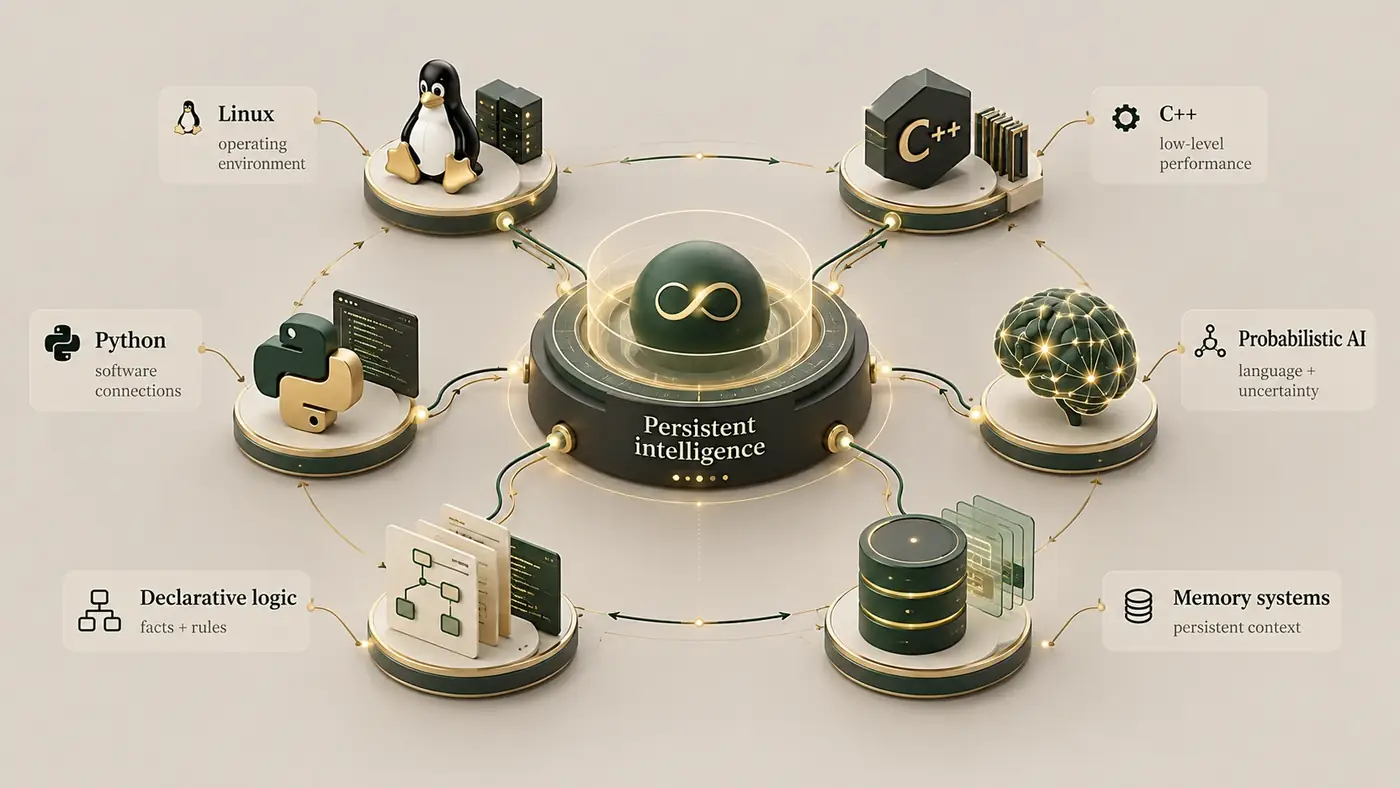
Persistent intelligence at the centre, supported by Linux, C++, Python, probabilistic AI, declarative logic and memory systems.
Reason

Ask AI the same question three times. You may get different answers.

That is how probabilistic AI works. It weighs possibilities and gives you the most likely answer, not a fixed one. For research, language and unclear situations, that is exactly what you want.

A declarative system works the other way. It follows rules.

The same question, asked three times“Can this $60,000 payment go out?”Illustration. Not real output.
Probabilistic AI

Explores. Adapts. Proposes.

It reasons from likelihood. It is strong wherever the answer has to be discovered, and a different answer each time is part of how it explores.

  1. Asked 1st“Looks fine. Send it.”
  2. Asked 2nd“That is a lot of money. Hold it.”
  3. Asked 3rd“Send it, if the supplier checks out.”

Three answers. Useful for exploring. Not what you want from a rule.

Deterministic, rule-based

Follows the rules. Every time.

It starts from facts that are accepted and rules that are written down, then works out what follows. It does not guess, so the same facts give the same result.

The ruleA payment over the company’s $50,000 daily limit does not go out.
  1. Asked 1stStop it.
  2. Asked 2ndStop it.
  3. Asked 3rdStop it.

Same facts. Same rule. Same answer.

How the system uses both

The system gives each kind of intelligence the job it is good at. Probabilistic AI explores and proposes. Rules and logic handle what has to come out the same every time.

Curious where the answer is unknown.
Exact where it has to be.

Curiosity finds the options. Rules keep the answer the same every time.

The human question

A Workday Is a System.

A person listens.

Remembers.

Investigates.

Uses different kinds of reasoning.

Asks specialists for help.

Acts.

Watches what happened.

Then carries that experience into what happens next.

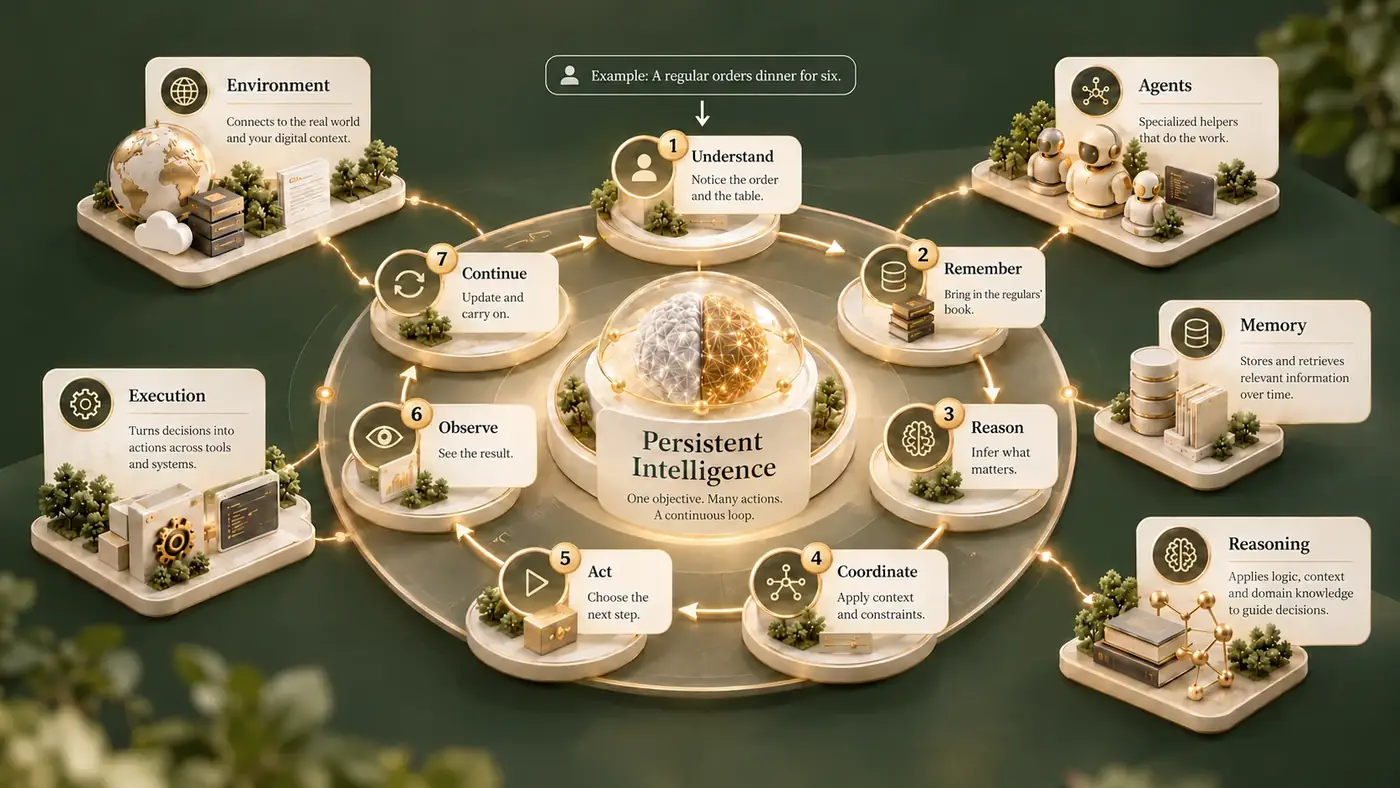
Persistent intelligence workflow: understand, remember, reason, coordinate, act, observe and continue, supported by environment, agents, memory, reasoning and execution.
The model is one component. The system is the intelligence.

Natural language is the interface. The architecture carries the work.

Why this architecture began

The system began as an attempt to do what one person does at a computer, start to finish. That goal led us to build an operating system around the model.

We built the system to explore what persistent intelligence needs in order to operate — to understand what is happening, remember what matters, reason, act, observe, and continue.

How it works

What Running Agents Taught Us.

Running many agents on one job showed us what they need: a loop that keeps going, memory with different lifetimes, rules where the answer must not change, and a system that holds the objective.

The runtime

What Runs Underneath the Workday

On the home page, the system does a person’s workday at a computer. This is what is running underneath. The system operates as a stateful software runtime above the Linux kernel. Linux provides the underlying environment for processes, networking, storage, and computing resources. The system coordinates the intelligence operating within that environment.

The runtime maintains the active objective, current state, relevant memory, agent responsibilities, and available tools. It receives information from connected systems, coordinates specialized work, applies probabilistic and declarative reasoning, executes actions through software interfaces, and observes what happens next.

The runtime’s main responsibilities
Linux hostProvides the processes, networking, filesystem, and computing resources on which the system operates.
Runtime stateMaintains the current objective, environmental context, active work, and changing system state.
Listeners and connectorsReceive information through APIs, events, connected applications, and external sources.
Agent coordinationOrganizes specialized agents and their work across multiple tasks and successive operations.
Memory servicesMaintain persistent knowledge, active-session context, and immediate working state.
Hybrid reasoningCombines probabilistic AI for interpretation and exploration with declarative logic for structured reasoning and constraints.
Tools and executionConnect to software and external systems, perform actions, observe results, and feed those results back into the ongoing process.
The operating loop

It Keeps Going Because It Is a Loop.

One objective can produce many actions. Each result changes the state of the work.

The outcome of one action becomes the context for the next.
Understand + remember

Context Has Different Lifetimes.

The world changes between prompts. The system keeps the right kind of memory for the right span of work.

Persistent memory

What should remain known.

Durable facts, history and knowledge that should survive the current task.

Session memory

What this body of work needs.

The details that matter while an active objective is under way.

Working memory

What is happening now.

Live agents, tools, environment and the current operation.

PERSISTENT Maria is a regular. She never eats shellfish. what should remain known SESSION Tonight is her birthday dinner for six. what this body of work needs WORKING Her order has just gone to the kitchen. what is happening now
Persistent
Maria is a regular. She never eats shellfish.what should remain known
Session
Tonight is her birthday dinner for six.what this body of work needs
Working
Her order has just gone to the kitchen.what is happening now

Example (restaurant): what a system with continuity should get right. It illustrates the idea and is not a deployment.

When the night is over, Maria is still a regular. The temporary state changes.

The proof is not that it remembers the past. The proof is that the past changes what it does next.
3 memories. 3 lifetimes. 1 operating system.
A practical consequence of the design

When the Model Gets Better, the System Keeps Going.

An old chat transcript tells a new model what was said. An operating system needs to carry more: what the system is trying to do, what it knows, what changed and what should happen next.

01 / Keep the objectiveThe work has a destination.

The objective belongs to the continuing system, rather than to one conversation.

02 / Keep the stateYesterday changes today.

Memory, decisions and observed results remain part of the work as the world changes.

03 / Change the modelBring in the next intelligence.

A different model can be coordinated around the existing objective and state, instead of starting from zero.

This is the architectural direction: continuity belongs to the system, not to a particular model. Full portability across arbitrary models remains a capability to prove.

Metacognition

Intent Has to Survive the Journey to Action.

A
What the person asked for.
B
What the model understood.
C
What the model told the tools to do.

Each handoff can change what the system understands or asks a tool to do. The objective must still guide the next action.

What am I doing? Why am I doing it? Does the next action still serve the objective?
Coordinate + act

Agents Do Tasks. The System Runs the Whole Job.

The agent

Has a job.

Research. Calculate. Investigate. Write software. Watch a source. Test an approach.

The system

Holds the objective.

The operating system carries the state, memory and coordination around the workers.

An agent performs a job.
The system coordinates what keeps the work moving.
Observe + continue

When Something Breaks, the Result Is New Information.

The tool returned an error.

The software worked.

The research contradicted the assumption.

The environment moved.

That changed state becomes part of the next decision.

ONE TECHNOLOGY SHOULDN’T DO EVERY JOB EITHER

Different Technologies. Different Jobs. One Operating System.

The system combines different technologies because different parts of intelligence require different strengths. The innovation is how those pieces work together around the same objective, memory and changing state.

The system brings these technologies together in one operating architecture. Linux provides the foundation. The runtime coordinates the other components around the same objective, memory, and changing state.

LinuxThe operating foundation.

The system is Linux-based. Linux provides the underlying environment in which the larger intelligence system operates.

Probabilistic AIHandles the uncertain.

Used for language, research, ambiguity and situations where the answer cannot be completely known in advance.

Declarative LogicHandles what can be known precisely.

Accepted facts, relationships and explicit rules let the system reason consistently where it should not have to guess.

Memory SystemsKeeps context alive across time.

Persistent, session and working memory preserve what should stay known, what matters during the current period, and what is in play right now.

Different technologies do different jobs. The system keeps them working as one persistent system.

The proving ground

We Ran It With Real Money.

Crypto trading is where we ran it, because the environment changes constantly and the consequences are real.

Top floorTrusted, higher-consequence responsibility.
Middle floorsSmaller live responsibilities. Approaches earn or lose trust.
Lower floorsResearch. Training. Testing. Competing strategies.
It has run in a live environment: information in, specialized intelligence in parallel, actions proposed, outcomes observed, state carried forward.

The application was trading. The architecture was the point.

The turn

Then Capability Became Consequence.

Change software.

Move a machine.

Commit resources.

Place an order.

The question changes when intelligence can make something real.

Capability does not create authority.

The more it can do, the more it matters that people stay in charge. Running the system exposed a second engineering problem: the system deciding what to do should not also be the final authority over what it may make real.

We could have kept racing to build a smarter AI. Instead we took what running agents taught us and focused it on one job: supervising them.

The system

Operates.

Persistent Intelligence carries the work forward.

Okren

Supervises.

Independent supervision: software that lets a person see every money move before it happens. It runs as separate software inside the customer’s environment and does not require the system. Limits set by people, applied by something that doesn’t work for the agent.

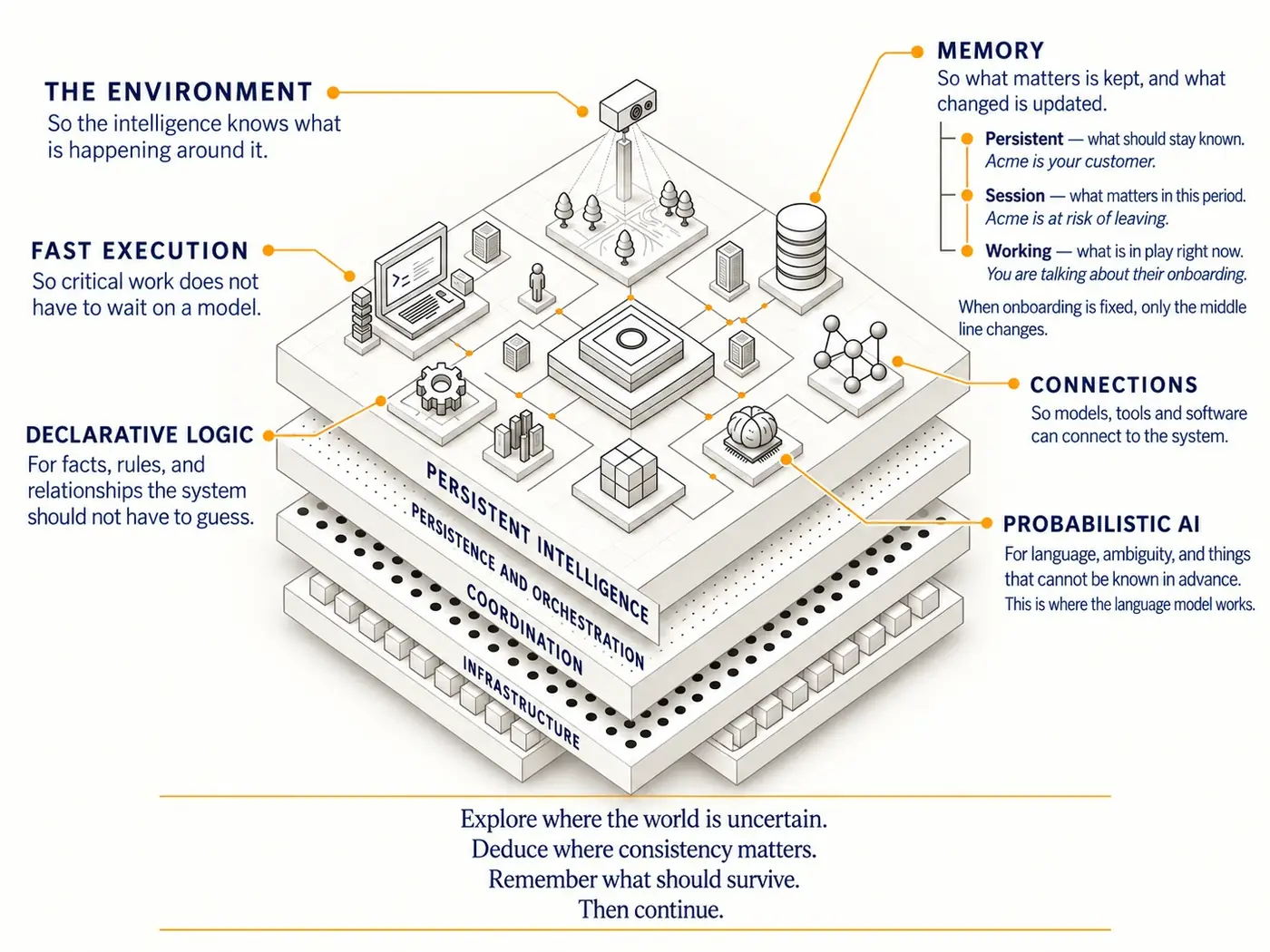
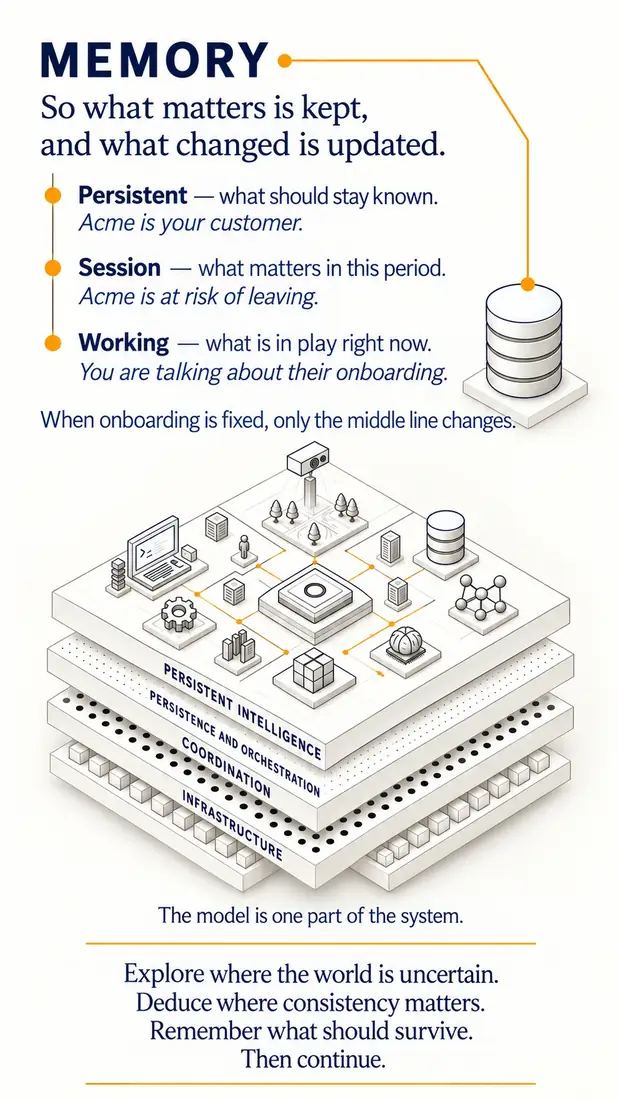
Layered architecture of persistent intelligence showing environment, fast execution, declarative logic, memory, connections and probabilistic AI. Layered architecture with environment, fast execution, declarative logic, memory, connections and probabilistic AI, arranged for tablet. Mobile illustration of persistent intelligence showing memory and the architecture layers with the system's key principle.
The system operates. Okren supervises.
How to check us

Don’t Take Our Word for It.

Here is what is documented, what OA describes, and what it keeps private.

Documented

Public, dated sources show the industry adding persistent memory, agents, tools and runtime responsibilities around models. Vendors are also starting to add controls inside their own agents. Independence from whoever runs the agent is the part we focus on.

Described by OA

The system’s architecture: three memory scopes, probabilistic and declarative reasoning, agents as workers, action, observation and continuation. This is OA’s own description.

Founder-reported

Work on the system began in 2021. The architecture has run in live environments, including one where its decisions had real consequences.

Not disclosed

Private implementation: schemas, retrieval methods, orchestration internals, prompts, security and source code.

The picture changes if another system integrates the full loop and publishes capability-level evidence, or if models themselves absorb more of these responsibilities.
Questions people usually ask

The Short Answers.

How is this different from an agent framework?

Frameworks give you parts: memory, workflows, tools, controls. The system is one design where those parts work together on the same job.

Is the system a runtime or an operating system?

Both terms describe different aspects of the system. An operating system for persistent intelligence describes the system’s architectural role: coordinating agents, memory, reasoning, tools, execution, and ongoing work as one system. A runtime describes the software that actually carries out those responsibilities. Technically, the system is a stateful runtime built on Linux. Linux provides the underlying operating-system foundation. The system provides the intelligence operating environment above it. The system does not replace the Linux kernel or function as a separate Linux distribution. A public installation is not currently offered.

How does the system relate to Okren?

The system operates. Okren supervises. In real terms, the system is OA’s architecture for running AI agents, and Okren is separate software, inside a customer’s environment, that lets a person check every money move before it happens. It does not need the system installed. Okren came second. It is what we built once running agents showed they need an independent check. See the product.

Is Okren independent of the system?

Yes. Okren runs as separate software and does not require the system. It supervises any AI that moves money, including the system’s own.

WHAT WE CHOSE NOT TO DO

What we chose not to do with this technology.

The same architecture could become many things. Here are three we looked at, and why each comes second.

Swipe or tap a use to change the example

A use we passed on · A phone you just talk toAn old handset, a new operating system, and no apps.
Why it comes second
Who it is for

What it would do

Why we passed

Each of these asks someone to trust AI with real responsibility, so each needs the same answer first: what is the AI allowed to do, and who decides? Okren is that answer, starting with money. That is why it is the product.
WHERE TO GO NEXT

The system operates. Okren supervises.

The instant check before the money moves, like every card payment.

Okren is where this research goes to work: independent supervision for AI that moves money, live with its first paying customer.

Picture a company whose AI pays three bills in one week.

  • A software bill, paid with a credit card.
  • A supplier, paid straight out of the company’s bank account.
  • A contractor, paid in crypto, because that is how he likes to be paid.

Each one has its own limit, and each one only counts what goes through itself. None of them can see the other two. So the company’s real rule, like “never more than $50,000 in a day,” is not kept by any of them. The AI can stay under all three limits and still go over the company’s.

And if the company changes its card, its bank or its crypto account, the old limit does not come along.

Okren keeps one limit, the company’s own, and checks every payment against it, however it is paid.

Outside the agent. Inside your system.

Why is Okren called the commercial proof?

Okren is the first product built from what running the system taught us, put to a real job with a real customer. It is separate software and runs on its own.

Go deeper

Want to Talk Through the Technology?

Technical conversations go deeper into runtime, system diagrams and the evidence behind the architecture.

Contact OA

Write to Freddie.

OA does not currently offer implementations or services. Use this for the technology, research, technical discussion, or Okren/investment context.

Okren is where this work is being built commercially. See Okren →
Freddie will also reply personally.
Email fallback

OA reads messages personally. No mailing list is created from this form.